You can read this blog post in English below
Vie ajatuksesi hetkeksi siihen ateriaan, jonka viimeksi söit. Miltä se maistui? Kuka sen valmisti? Mitä kaikkia ruoka-aineita lautasellasi, tai kenties kädessäsi, oli?
Tiedätkö, miten ruoka-aineet olivat ateriaasi päätyneet? Mistä ne olivat matkanneet?
Jos söit maitotuotteita: mitä lehmät olivat syöneet? Miten he elivät? Koska heidän synnyttämänsä vasikat oli otettu heiltä pois? Miten heitä oli lypsetty?
Jos söit vihanneksia: kuka oli kylvänyt siemenet? Millaisessa maaperässä vihannekset kasvoivat? Vai kasvoivatko ne kenties ravinneliuoksessa? Oliko niiden pinnalla torjunta-ainejäämiä? Kenen kädet olivat korjanneet sadon?
Jos söit lihaa: oliko eläimellä nimeä? Miten hän eli? Miten hän kuoli? Kuka hänet tappoi? Kuinka pitkän matkaa hän ruhonsa osa kulki lähikauppaasi? Mitä tuottajalle hänestä maksettiin?
Nyt: sulje silmäsi. Hengitä. Kuvittele, kuinka lautasellasi oleva ruoka päätyi osaksi sinua. Se imeytyi verenkiertoosi, alkoi ravita solujasi, ruokkia aivojasi. Kaikki se, millä ruokaasi oli ravittu ja miten se oli kasvatettu, prosessoitu ja luoksesi kuljetettu alkaa vaikuttaa myös sinuun. Ruoka muuttuu sinuksi; sinä muutut ruuan ansiosta.
***
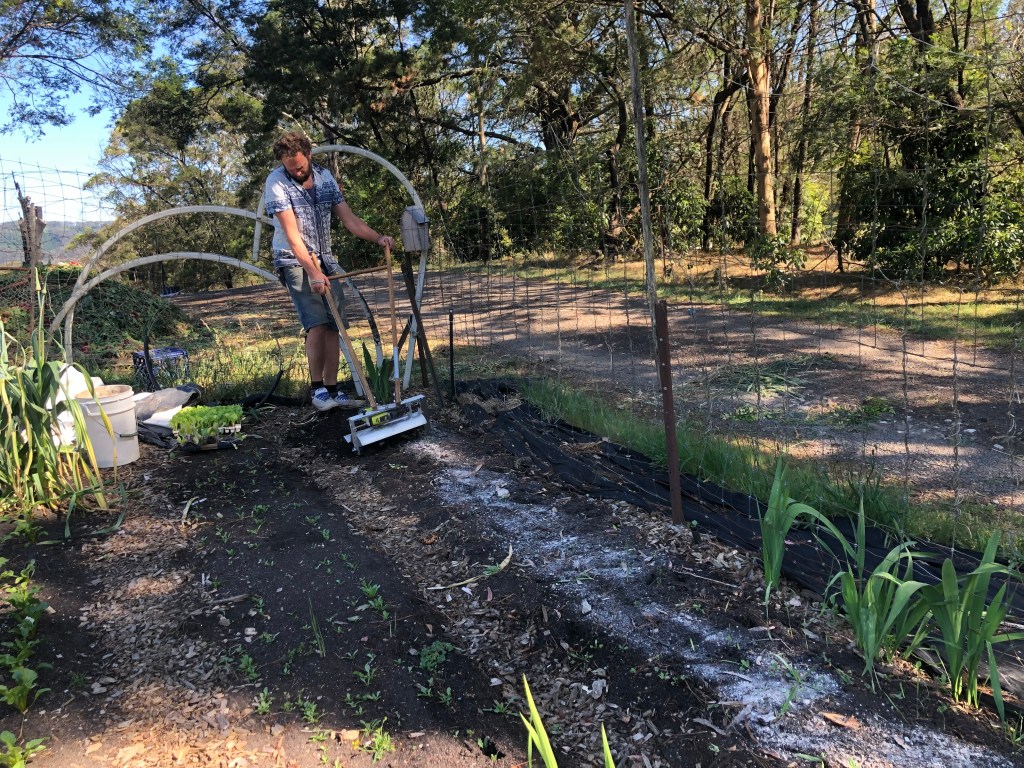
Jalkani työntyvät pehmeästi pöllyävän mullan sisään. Etenen tasaista tahtia kantaen painavaa sankoa, josta kauhon paljaalla kädellä jauhetta ja tuuli apunani levitän sitä vasta kynnetylle peltotilkulle. Tunnen auringon paahteen niskassani, käsivarsissani, pohkeissani. Mustat paljasjalkalenkkarini suorastaan liimautuvat kuuman kääreen lailla jalkaani vasten. Perässäni ajaa hiljaa traktori ja möyhii pellolle levittämämme ravintolisän mullan sekaan.
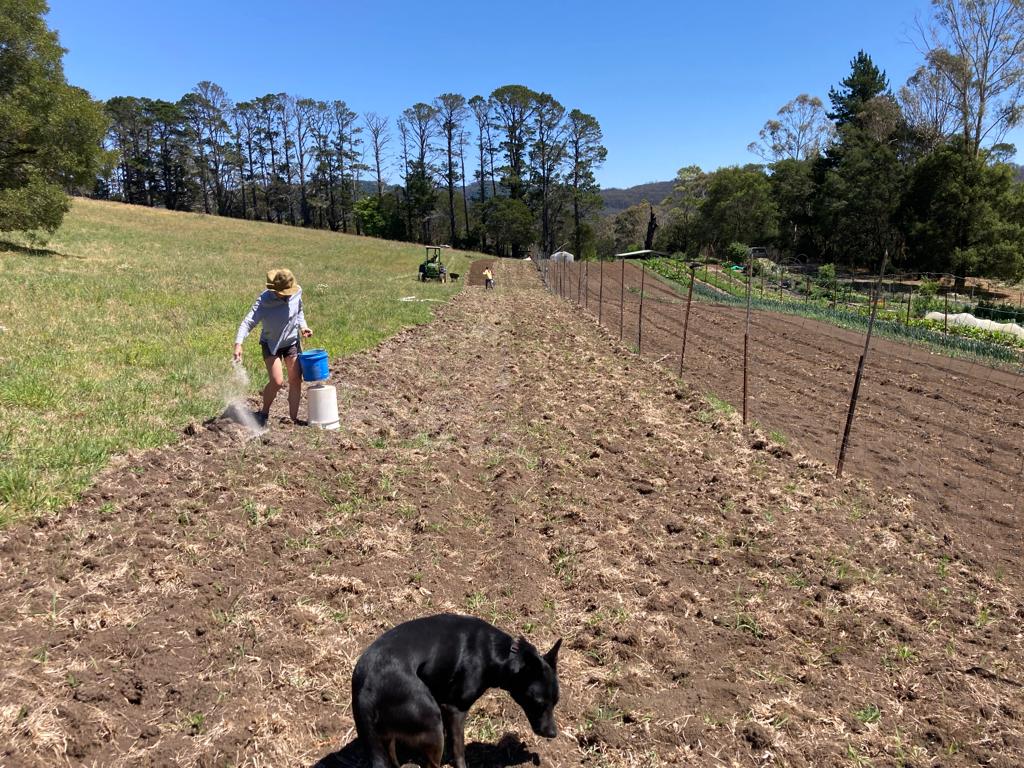
Valmistelemme alaa perunan istutuksia varten. Maa saa olla vielä hetken paljaana, sillä välissä tehdään monia muita asioita: pystytetään tolppia tulevaa tomaattirivistöä varten, korjataan satoa CSA-satokasseihin, kastellaan taimia, kitketään penkkejä, kylvetään uusia siemeniä, istutetaan taimia, valmistellaan lisää penkkejä, “putsataan” penkkejä seuraavia istutuksia varten.
Vihannesten kasvatuksessa on kymmeniä työvaiheita ennen kuin ne kypsyvät korjuukelpoisiksi.
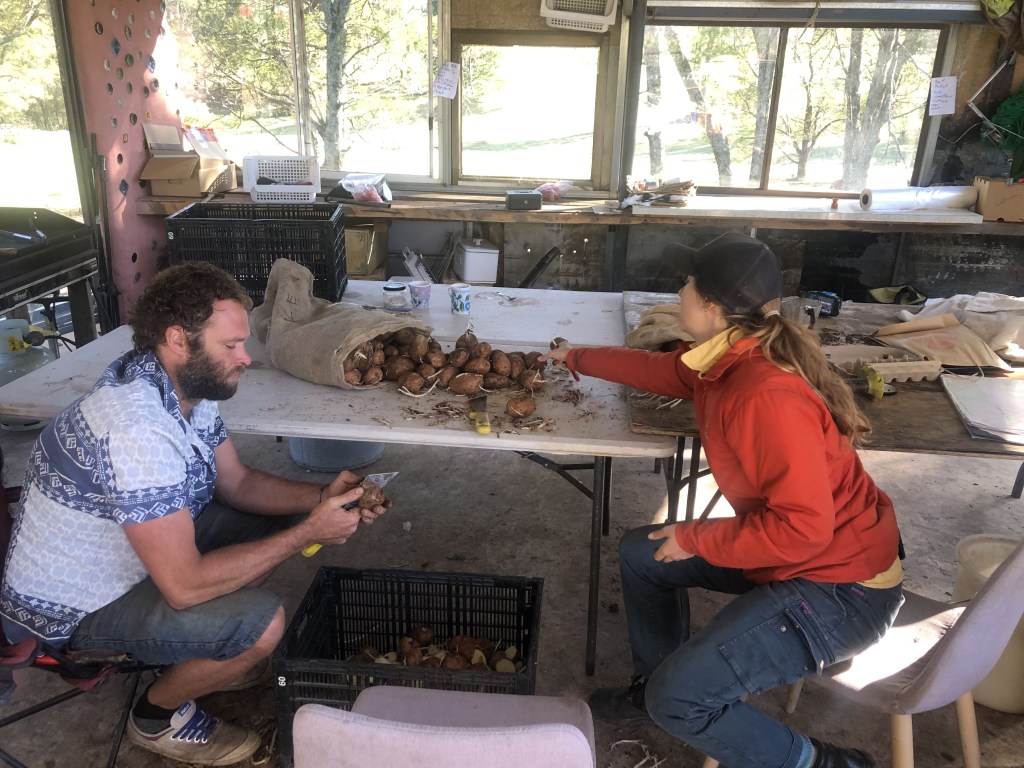
Ennen kuin perunat vihdoin tiputellaan peltoon muutaman päivän päästä vietämme kokonaisen aamupäivän leikaten niitä pienemmiksi palasiksi. Näin yhdestä siemenperunasta voi kasvaa kolme kasvia, kunhan on tarkkana leikkaamisen kanssa ja jättää tarpeeksi itusilmuja jokaiseen palaan.
Iltapäivällä naapuri hurauttaa paikalle istutuskoneen kanssa. Sillä on yleensä istuteltu puita ja muita taimia, ei koskaan ennen perunaa. Nyt on tarkoitus kokeilla perunanistutusta. Istun koneen perällä Aaronin kanssa. Meille ojennetaan painavia koreja täynnä lohkottuja siemenperunoita. Kone liikahtaa, me horjahdamme ja heti tasapainon korjattuamme alamme tiputella perunoita koneen tekemään vakoon.
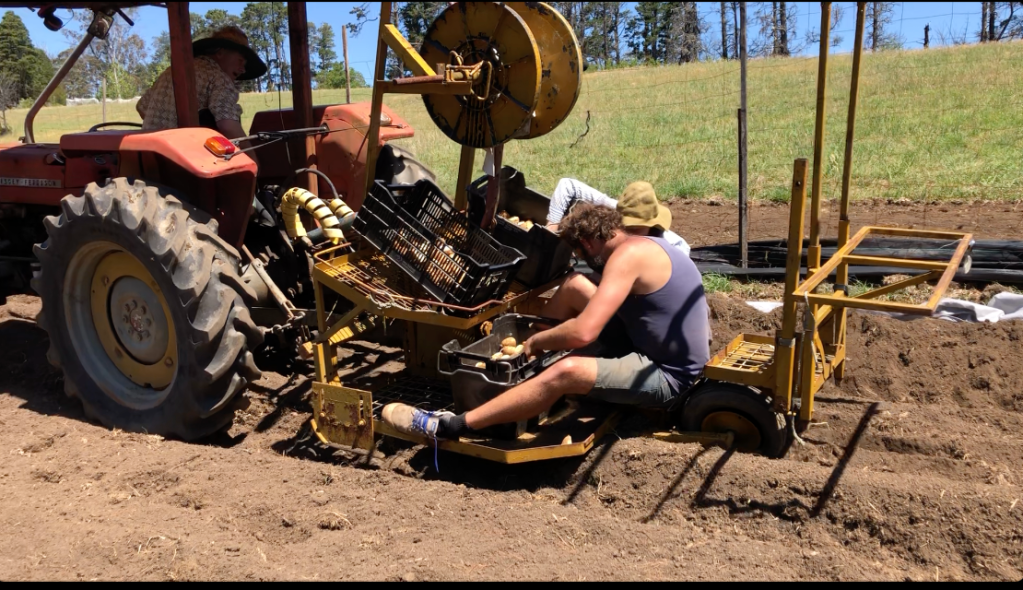
Koetamme löytää rytmiä: toinen kaappaa kasan perunoita käteen sillä välin kun toinen tiputtelee, ja sitten vaihdamme rooleja. Tarkoitus on saada perunat n. 30cm välille ja n. 20cm syvyydelle. Arvioimme nopeutta suhteessa kykyymme tiputella perunoita, pyydämme hidastamaan. Vako vaikuttaa liian syvältä, pyydämme nostamaan auraa.
Perunat eviät tipahtele tasaisesti mutta vähenevät kyllä melko tasaiseen tahtiin. Laatikot pitäisi riittää ennakkoon lasketulle alalle. Miten meillä sen kanssa sujuu? Täytyy hidastaa tahtia, eikä tiputella niin tiheästi. Ja näin jatkuvasti muokkaamme toimintaamme koneen toimintaan sopivaksi ja sovitamme konetta maaperän ja perunoiden kasvuominaisuuksiin.
Aurinko paahtaa kuumana selkään ja paljaisiin nilkkoihin. Multa pöllyää ja toivon, että kädessäni olisi jo viimeinen kori. Meitä on yhteensä neljä henkilöä perunanistutuksessa. Vaihdamme rooleja lennosta.
Myöhemmin perunanvarsien kasvaessa perunat tullaan multamaan, luultavasti pariin otteeseen. Niitä tullaan ehkä kastelemaan ja tarkastamaan tuholaisten varalle. Kun perunat vihdoin kypsyvät, ne tullaan korjaamaan, todennäiköisesti talikon voimin ja kuljettamaan pakettiautolla satokumppaneille, torille ja kauppoihin.
Vaikka perunan kasvattaminen vaatii monta vaihetta, niin se ei suinkaan ole kasvi työläimmästä päästä verrattuna vaikkapa salaattiin tai tomaattiin, jotka viljelijät kylvävät siemenestä. Siemenen kasvattaminen taimeksi vaatii jatkuvaa huolenpitoa, joka päiväistä kastelua, ravitsemista, koulimista, ulkoiluttamista.
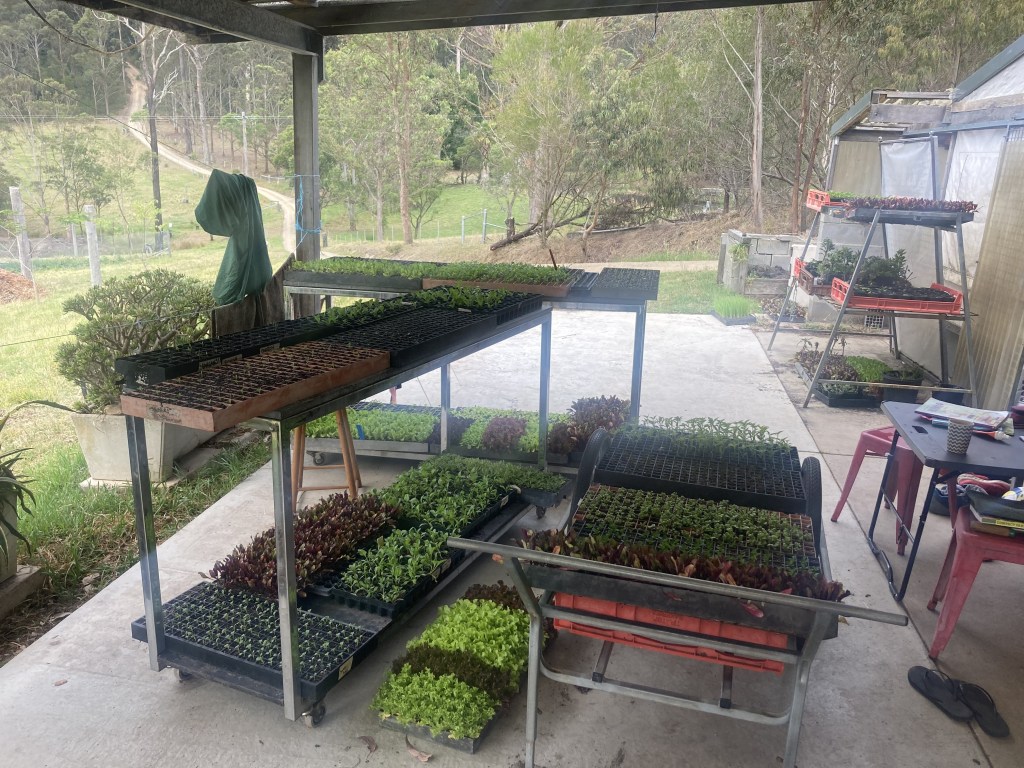

Ennen kuin taimet lopulta pääsevät maahan, täytyy kasvupenkit valmistella ja taimien alkuun pääsy varmistaa sekä taata jatkuva vedensaanti. Tomaattien osalta pitää huolehtia pölytyksestä ja varkaiden poistamisesta, latvomisesta ja pitkien varsien ohjaamisesta.
Ja näin jokaisen kasvin kohdalla on erikseen ymmärrettävä kasvin metamorfoosia, eli muodonmuutosta ja koetettava mahdollistaa kasville parhaat kasvuolosuhteet sen eri kasvuvaiheissa.
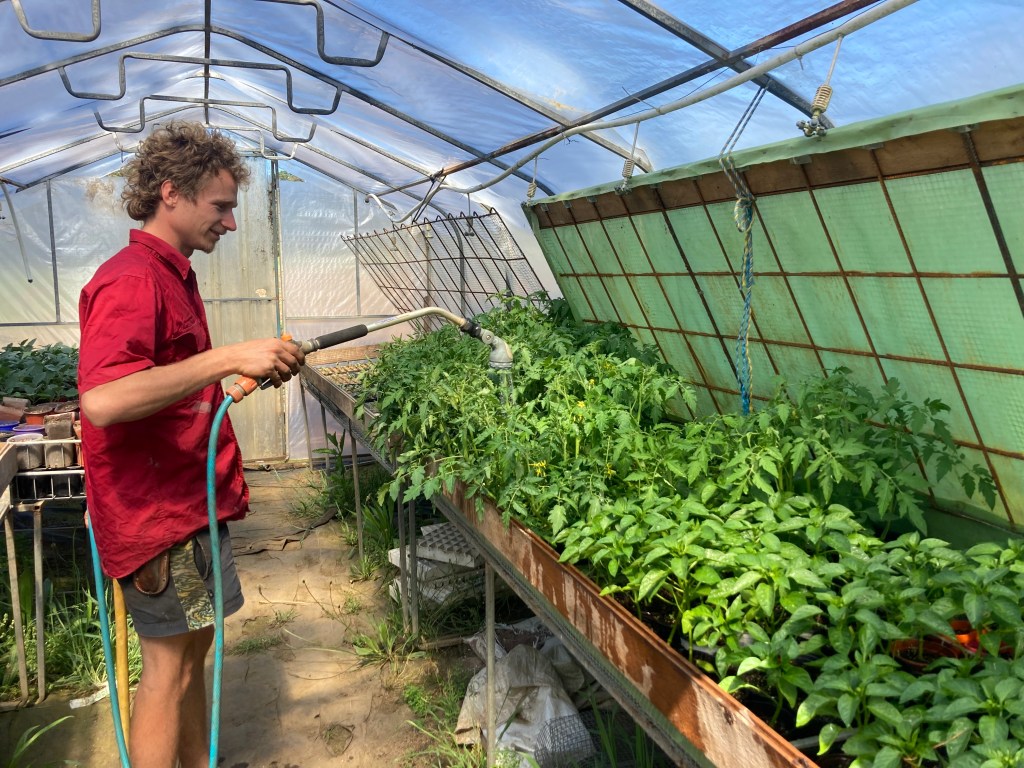
Sadonkorjuu on yhtälailla käsityöintensiivistä ja taitoa vaativaa. Jokainen kasvi on omanlaisensa ja sen poimiminen tai pellosta korjaaminen on tarkkaa hommaa ettei kasvi vaurioitu. Ennen kuin sato päätyy loppukäyttäjän pöytään, se pitää putsata, niputtaa ja pakata. Eläimen teurastus jos mikä on niin ikään tarkkuutta ja taidokkuutta vaativaa käsityöhommaa!
Kasvien ja eläinten hoitaminen ja kasvatus uudistavuuteen pyrkivillä maatiloilla ovat Australiassa näyttäytyneet minulle erityisessä valossa. Etäisyys on auttanut huomaamaan asioita, jotka Suomessa ovat jääneet taustalle.
Yksi näistä on monimuotoisen pienviljelyn käsityöläisyys.
Puhumme käsityöläisyydestä viitatessamme esimerkiksi saviastioiden, korujen tai muunlaisten käsitöiden tekemiseen. Käsityöläisyys liitetään ensisijaisesti esineisiin ja niiden valmistamiseen. Käsityöläisyys viittaa erikoistaitojen omaamiseen ja vaalimiseen; käsityöläisen lopputuotos on esteettisesti houkutteleva käyttö- tai koriste-esine.
Monimuotoinen pienviljely on juuri näitä kaikkia edellä mainittuja asioita: suunnittelua ja aikaa vaativaa, taidokkaalla käsityöllä toteutettua. Lopputuloksena ei ole pelkästään esteettisesti vaan myös maultaan ja ravitsemuksellisesti houkutteleva lopputuotos.
Luonnonmukaisesti viljellyn ruuan erona esineisiin on myös se, että perinteisemmäksi mielletyn käsityöläisyyden yhdeydessä ei välttämättä kiinnitetä huomiota siihen, mistä käsityöhön käytettävä raaka-aine tulee: Millaisen jäljen saven kaivaminen on maahan jättänyt? Miten villasukissa käytetyn langan mahdollistaneet lampaat ovat eläneet? Millainen ekosysteemi on tuhoutunut tuoliin käytetyn puun saamiseksi? Miten mehiläisvahakynttilää varten otetun vahan tehneitä mehiläisiä on kohdeltu?
Monimuotoisessa ja uudistavuuten pyrkivässä pienvieljelyssä raaka-aineiden alkuperän jäljittäminen ja tietoisuus niiden valmistuprosesseista taas on oleellinen osa viljelyä: se mitä kompostiin on laitettu päätyy ravitsemaan maaperää ja kasveja; se miten siemenet on kasvatettu vaikuttaa kasvin makuun, estetiikkaan, ravitsemukseen; se millä eläimiä on ruokittu pääty osaksi heidän lihaa ja muita ruuaksi kelpaavia tuotoksia.
***
Seisomme Kirstin kanssa paljaalla, kuumalla ja kuivalla Walbunja ja Brinja-Yuin -kansojen maalla ja pohdimme, kuinka suuret välit jätämme salaatin taimien väliin. Piirräämme käsillämme ilmaan ympyröitä havainnollistaaksemme millaiseksi juuri tämä jäävuorisaalaattilajike tulee kasvamaan. Sommittelemme salaatin taimia penkkeihin siksak-muotoon. “Tämä on kyllä suurta taitoa ja taiteellista silmää vaativaa hommaa”, totean Kirstille. “Niin. Ja ajattele, kuinka monta kertaa meidän kädet koskevat näihin salaatteihin”, vastaa Kirsti.
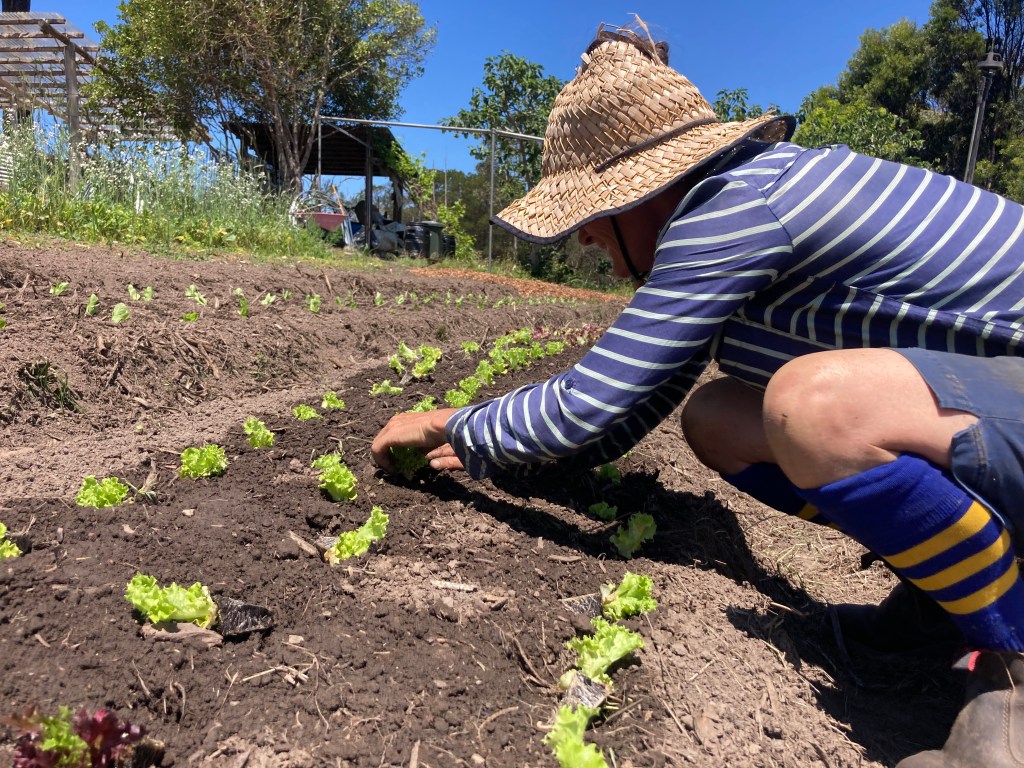
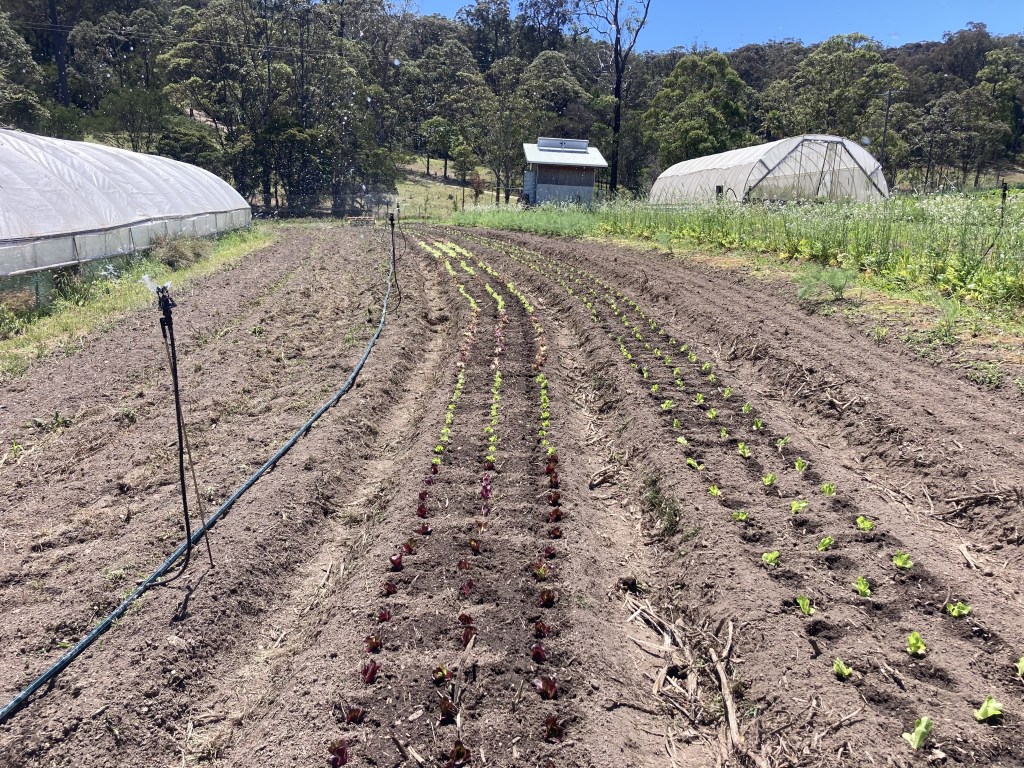
Jokainen vihannes, kananmuna, lihanpala, ja yrtti ja jokunen viljanjyvänen on kulkenut lukemattomien kädenkosketusten läpi. Käsityön määrää on vaikea kuvata ilman, että lukija (tai kuulija) tulkitsee kuvauksen romantisointina. Mutta sitä minun ei ole tarkoitus tehdä: toisessa kohtaa voin ottaa kantaa siihen, mitä merkitystä niin valtavalla käsityöläisyyden määrällä on ja onko se, niin sanotusti, kannattavaa.
Tässä kirjoituksessa haluan tuoda tämän havainnon esiin ilman normatiivista tulkintaa: viljelijät ja heidän ohjauksellaan muut tilalla työskentelevät käyttävät suurimman osan ajasta erilaisten työvaiheiden suorittamiseen käsin käyttäen apunaan myös erilaisia ja eri kokoisia koneita.
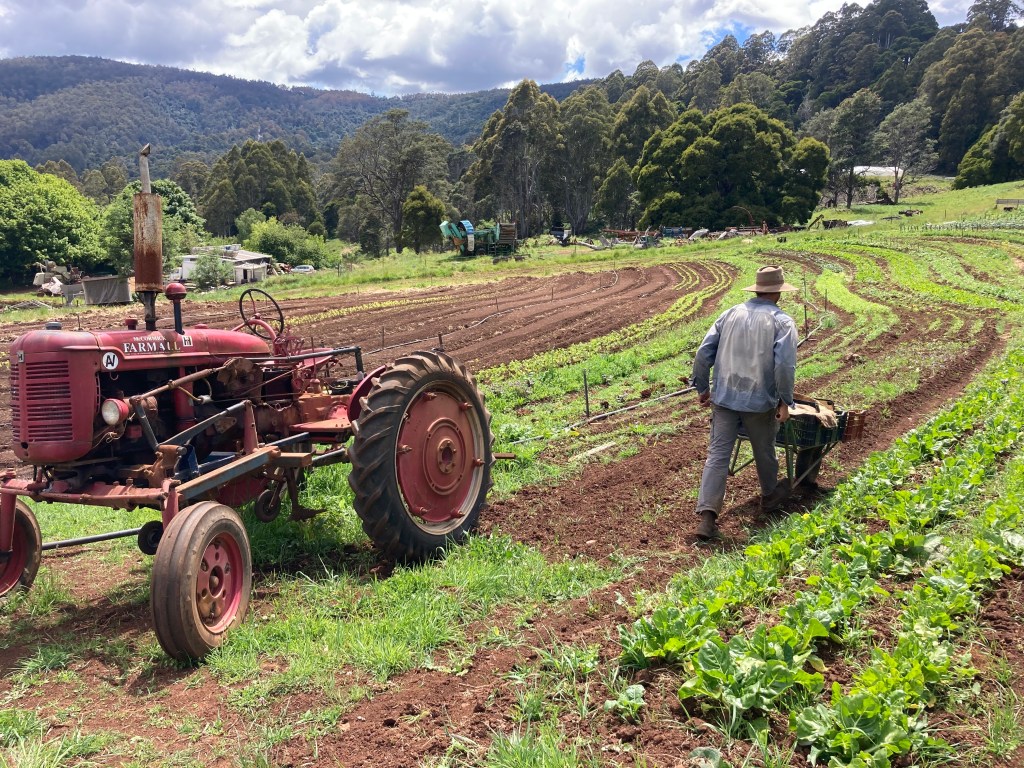
Vihannesten kasvatus ja eläintenpito vaativat jatkuvaa ja päivittäistä huolenpitoa. Kaikki tämä arjen työ lukuisine työvaiheineen, suunnitteluineen, hoivaamisineen, reagointeineen, päätöksien tekemisineen, epävarmuuksineen, uupumuksineen, toiveikkuuksineen, taitoineen, ja energian käyttämisineen jää näkymättömiin heille, keiden kasseihin salaatinkerät ja muut ruoka-aineet päätyvät.
Näkymättömyys ei sinänsä ole haitallista, sillä eihän villasukkien kutojan tai linnunpönttöjen tekijän työkään ole asiakkaille näkyvää. Mutta ruuan osalta ei tule helposti ajateltua sitä, kuinka paljon käsityötä ja luovuutta maukkaan, ravitsevan ja kauniin ruuan kasvattaminen vaatii; että ruoka ei kasva itsekseen niin, että viljelijä vain korjaa sadon.
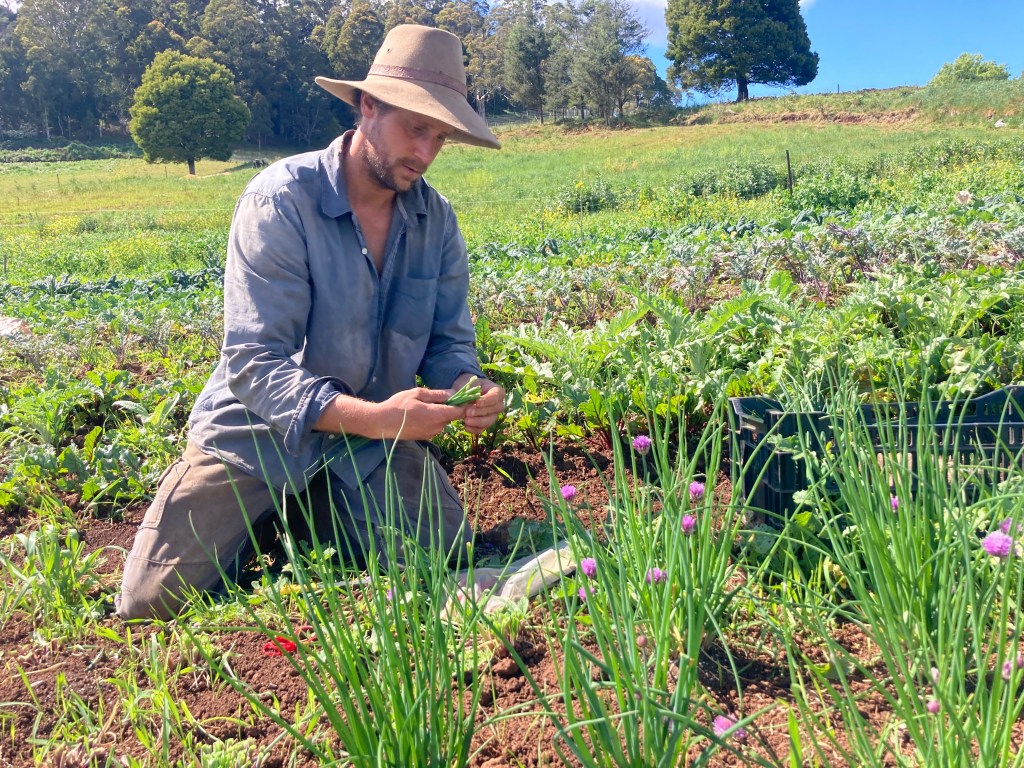
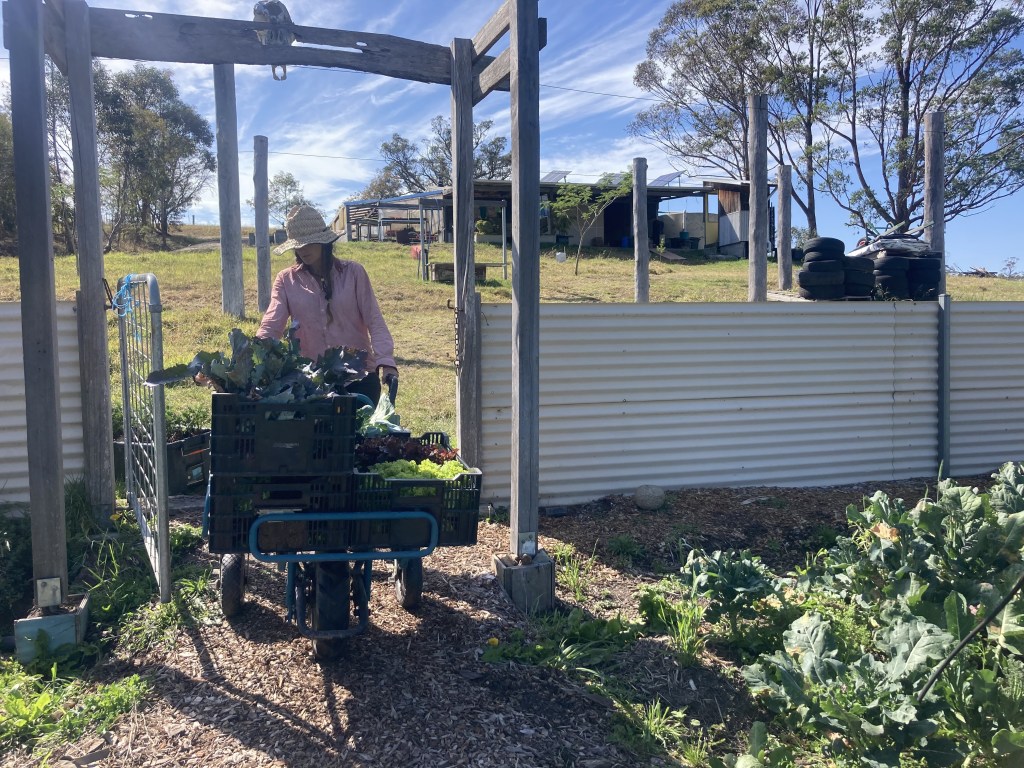
“Ehkä viljelyä ei käsitetä käsityöläisyyteen verrattavaksi toiminnaksi siksi, että niin moni kuitenkin pystyy kasvattamaan vaikkapa yrttejä tai vihanneksia kotipihallaan. Viljelyn perusteet eivät vaadi erikoisia taitoja tai koulutusta, joita esimerkiksi lasinpuhaltalta vaaditaan. Kuka tahansa voi tähän ryhtyä”, toteaa Brinja-Yuin -kansojen mailla kumppanuusmaataloustilaa puolisonsa kanssa pyörittävä Fraser. “Mutta ehkä viljelyn käsityöläisyys piileekiin siinä, että saa tästä elannon. Se vaatii taitoa, eikä siihen jokainen pysty.”
***
Katson multaisia kynnenalusiani ja halkeilevia, tummuneita sormenpäitäni. Tunnen ihooni paahtuneet rusketusraidat. Kauhon lautaselleni lounaaksi viljelypoppoolle tekemääni salaattia, jonka lajikirjo kohoaa yli kymmenneen sisältäen alkukesän kasviksia ja yrttejä.

Istumme vihanneslaatikoiden ja satunnaisten ämpäreiden päällä tauko- ja kauppakunnostustilassa olevan pöydän ympärillä. Puheensorina ja satunnaiset naurun purskahdukset siivittävät lounashetkeämme.
Kunpa saisin taltioitua hetken niin, että voisin jakaa sisältäni kumpuavan kiitollisuuden tunteen. Kunpa nämä ihmiset voisivat välittää käsityöläisyyden eetosta jokaisen satokassin yhteydessä, mietin. Kunpa suurempi osa ihmisistä täällä länsimaissa välittäisi siitä, millaiseksi heidän syömänsä ruoka muokkaa heitä ja ympäristöä lähellä ja kaukana.
Kunpa.
Australia, chapter 11: Craftsmanship in diversified small-scale farming
Take a moment to think back to the meal you last ate. How did it taste? Who prepared it? What ingredients were on your plate, or perhaps in your hand?
Do you know how the ingredients ended up in your meal? Where had they traveled from?
If you ate dairy products: what had the cows eaten? How did they live? When were their calves taken away from them? How were they milked?
If you ate vegetables: who had planted the seeds? What kind of soil did the vegetables grow in? Or did they perhaps grow in a nutrient liquid? Were there any pesticide residues on their surface? Whose hands harvested the crop?
If you ate meat: did the animal have a name? How did it live? How did it die? Who killed it? How far did its body parts travel to your local store? What was the producer paid for it?
Now: close your eyes. Breathe. Imagine how the food on your plate became a part of you. It absorbed into your bloodstream, began nourishing your cells, feeding your brain. Everything with which your food was nourished and how it was grown, processed, and transported to you also begins to affect you. Food becomes you; you become food.
My feet sink softly into the loosely dusty soil. I advance at a steady pace, carrying a heavy bucket from which I scoop handfuls of powder with my bare hand, and with the help of the wind, I spread it onto the freshly plowed patch of land. I feel the sun’s heat on the back of my neck, on my arms, and calves. My black barefoot sneakers stick to my feet like a hot wrap. Behind me, a tractor drives slowly, blending the nutritional supplement we spread onto the field into the soil.
We are preparing the area for potato planting. The soil can remain bare for a while because in the meantime, many other tasks need to be done: setting up posts for the upcoming tomato rows, harvesting crops for CSA shares, watering seedlings, weeding beds, sowing new seeds, planting seedlings, preparing more beds, and “cleaning” beds for the next plantings.
There are dozens of steps involved in growing vegetables before they mature and are ready for harvest.
Before the potatoes are finally dropped into the field in a few days, we spend a whole morning cutting them into smaller pieces. This way, one seed potato can grow into three plants, as long as we are careful with the cutting and leave enough sprouts on each piece.
In the afternoon, the neighbor arrives with a planting machine. It’s usually used for planting trees and other seedlings, never before for potatoes. Now, we’re going to try potato planting with it. I sit at the back of the machine with Aaron. Heavy baskets filled with halved seed potatoes are handed to us. The machine starts moving, we sway a bit, and as soon as we regain our balance, we begin dropping the potatoes into the furrow made by the machine.
We try to find a rhythm: one of us grabs a pile of potatoes while the other drops them, and then we switch roles. The aim is to space the potatoes approximately 30cm apart and about 20cm deep. We assess our speed relative to our ability to drop potatoes and ask to slow down. The furrow seems too deep, so we ask to raise the plow.
The potatoes don’t fall evenly but do diminish at a fairly consistent rate. The boxes should be enough for the predetermined area. How are we doing with that? We have to slow down and not drop them so closely. And thus, we constantly adjust our actions to fit the machine’s operation and adapt the machine to the soil and the growth characteristics of the potatoes.
The sun beats down hot on our backs and bare ankles. Dust swirls, and I hope to have the last basket in my hand soon. There are a total of four of us planting potatoes. We switch roles on the fly.
Later, as the potato vines grow, they will be hilled, probably a couple of times. They may be watered and checked for pests. When the potatoes finally mature, they will be harvested, most likely by hand and transported by van to our partners, the market, and stores.
While growing potatoes involves many steps, it’s not necessarily one of the most labor-intensive crops compared to, say, lettuce or tomatoes, which farmers sow from seed. Growing a seed into a seedling requires constant care, daily watering, nourishing, transplanting, and hardening off.
Before the seedlings finally make it into the ground, the beds must be prepared, and access to the seedlings ensured, along with ensuring continuous water supply. For tomatoes, pollination must be taken care of, suckers removed, and tall stems guided.
And so, with each plant, it’s important to understand the metamorphosis, or transformation, of the plant and strive to provide the best growing conditions for it at its different stages of growth.
Harvesting is just as labor-intensive and skill-demanding. Each plant is unique, and picking or harvesting from the field requires precision to avoid damaging the plants. Before the produce reaches the end user’s table, it needs to be cleaned, bundled, and packed. Animal slaughter, likewise, requires precision and skillful craftsmanship!
Caring for plants and animals on regenerative farms in Australia has shown me a different perspective. The distance has helped me notice things that might have been overlooked in Finland.
One of these is the craftsmanship of diversified small-scale farming.
When we talk about craftsmanship, we typically refer to the making of pottery, jewelry, or other handcrafted items. Craftsmanship is primarily associated with objects and their production. Craftsmanship involves possessing and nurturing specialized skills; the artisan’s end product is aesthetically pleasing and functional or decorative.
Diversified small-scale farming embodies all these aforementioned aspects: it requires planning and time, executed with skillful craftsmanship. The result is not only aesthetically but also gustatorily and nutritionally appealing.
Unlike handcrafted items traditionally associated with craftsmanship, organic farming also considers the origin of the raw materials: What impact did digging up the clay leave on the earth? How were the sheep, whose wool is used in the knitted socks, treated? What ecosystem was destroyed to obtain the wood for the chair? How were the bees, whose wax was used for the beeswax candle, treated?
In diversified and regenerative small-scale farming, tracing the origin of the raw materials and awareness of their production processes are essential: what is put into the compost nourishes the soil and plants; how the seeds are grown affects the taste, aesthetics, and nutrition of the plant; how animals are fed becomes part of their meat and other edible products.
***
Kirsti and I stand on the bare, hot, and dry land of the Walbunja and Brinja-Yuin peoples, pondering how much space we leave between the lettuce seedlings. With our hands, we draw circles in the air to illustrate what this particular iceberg lettuce variety will grow into. We arrange the lettuce seedlings in zigzag patterns in the beds. “This is indeed a great skill and requires an artistic eye,” I remark to Kirsti. “Yes. And think about how many times our hands touch these lettuces,” Kirsti replies.
Every vegetable, chicken egg, piece of meat, and herb, along with every grain of wheat, has passed through countless hands. Describing the extent of craftsmanship is difficult without the risk of the description being interpreted as romanticizing. But that’s not my intention: at another point, I can discuss the significance of such extensive craftsmanship and whether it is, so to speak, worthwhile.
In this writing, I want to highlight this observation without a normative interpretation: farmers and those working under their guidance on the farm spend most of their time performing various tasks by hand, using various sizes of machines as well.
The cultivation of vegetables and the care of animals require continuous and daily attention. All of this everyday work, with its numerous tasks, planning, nurturing, reacting, decision-making, uncertainties, exhaustion, hopes, skills, and energy expenditure, remains invisible to those whose shopping bags receive the harvested salads and other food items.
Invisibility per se is not necessarily harmful, as the work of knitting wool socks or making birdhouses is not visible to customers either. However, when it comes to food, it’s not easy to think about how much craftsmanship and creativity it takes to grow tasty, nutritious, and beautiful food; that food doesn’t just grow by itself and that the farmer merely harvests the crop.
“Perhaps farming isn’t perceived as comparable to craftsmanship because so many people can grow herbs or vegetables in their backyard. The basics of farming don’t require specialized skills or training like those needed for glassblowing, for example. Anyone can take it up,” says Fraser, who runs a partnership farm with his partner on the lands of the Brinja-Yuin peoples.
“But maybe the craftsmanship of farming lies in making a living from it. It requires skill, and not everyone can do it.”
**
I look at my muddy fingernails and cracked, darkened fingertips. I feel the sun-baked tan lines on my skin. I scoop onto my plate a salad I made for lunch for the farming team, its variety spanning over ten ingredients, including early summer vegetables and herbs.
We sit around a table in the break and market preparation area, perched on vegetable crates and random buckets. The buzz of conversation and occasional bursts of laughter accompany our lunchtime.
I wish I could capture this moment, so I could share the feeling of gratitude welling up inside me. I wish these people could convey the ethos of craftsmanship with every share of produce, I ponder. I wish a larger portion of people here in the Western world cared about how their food shapes them and the environment, both near and far.
I wish.



 Galina Kallio